
Tobias Kappel
Updated: Feb 19
Berlin-based artist Tobias Kappel’s practice unfolds in the subtle territory where images lose their certainty. He works with photography and digital processes to translate, distort, and reassemble visual material creating works that hover between analogue memory and digital abstraction. After a solo exhibition in Tokyo in 2024, he is preparing new projects for the upcoming year. In this interview, we take a closer look at the roots that shaped his artistic journey.

Can you tell us about your background and how you started working as an artist, leading up to where you are now?
I have a bit of a background in graffiti and spent a lot of my teenage years attending life drawing classes. Later, I studied Communication Design at a University of Fine Arts in Germany, focusing on photography. I explored photography further in a second program and eventually went to New York for an internship at Pari Dukovic Studio.
Returning to Germany, I felt a bit lost. My time abroad made me realize that I didn’t want to pursue photography as a profession and how much I was drawn to Berlin in comparison to NYC. So I moved to Berlin, worked for an art magazine and an artist’s estate, and spent my nights and weekends unlearning, questioning, and quietly rebuilding the way I understand images.
A recommendation eventually brought me to Robert Morat Galerie, where I still work part-time as lead director. The rest of the time I dedicate to my own artistic practice.

What are some of the key things you value in your artistic style and creative process?
I’m not sure I’ve reached a fixed artistic “style” yet. I’m drawn to the idea that an image or artwork doesn’t have to be fixed or final, plus I think its interesting when its losing categorization entirely.
Much of my practice is shaped by the idea of the in-between. I grew up during the shift from analogue to digital, in a world that feels like it’s constantly moving and transforming. I’m fascinated by how meaning mutates through translation, reinterpretation, or simple technological interference, like reproduction or glitches for example.

We’d love to hear about your current base of activity. What do you find inspiring about Berlin, and why have you chosen to create there?
I’m originally from Potsdam, so Berlin has always been close, though for most of my youth, I wanted nothing more than to leave. Aside from its graffiti, the city didn’t interest me at all back then.
That changed one summer when I spent time here with a friend who introduced me to scenes I’m still drawn to today and helped me understand what makes Berlin such a vibrant place for young artists.
Berlin has naturally changed a lot since then. Things like the cost of living or how politically divided it feels now can sometimes almost seem surreal. There used to be so much space in the city, both physically and mentally, probably rooted in its post-war history, where things felt unclaimed and undefined. While it’s still home and I have a close community of friends here, some of the freedom that once defined the city has inevitably shifted.
Last year, you held a solo exhibition in Tokyo. Could you share how that came about?
In 2021, I expanded my practice by curating and participating in open-ended photography at Robert Morat Galerie during its summer break. The idea was to broaden the gallery’s programme and bring together Berlin-based artists, encouraging a more independent way of seeing and thinking through images.
By chance, Yukitomo Hamasaki visited the exhibition while he was in Berlin. He connected with the work, followed me on Instagram, and reached out sometime later after establishing LOWW Gallery in Tokyo in 2023. Looking back, I’m truly grateful that this exhibition led to a meaningful connection with Yukitomo / LOWW, and ultimately the opportunity to hold my solo show inthein in Tokyo.
Have you had exhibitions outside your home country?
Not as many as I’d like. Some time ago, I took part in the Contact Photography Festival in Toronto, Canada, and I was invited to exhibit in gallery 302 in Katowice, Poland, next year. Other than that, I’m always open to new opportunities to show my work or collaborate,
Could you tell us about your favorite or most meaningful piece of work, and why it is special to you?
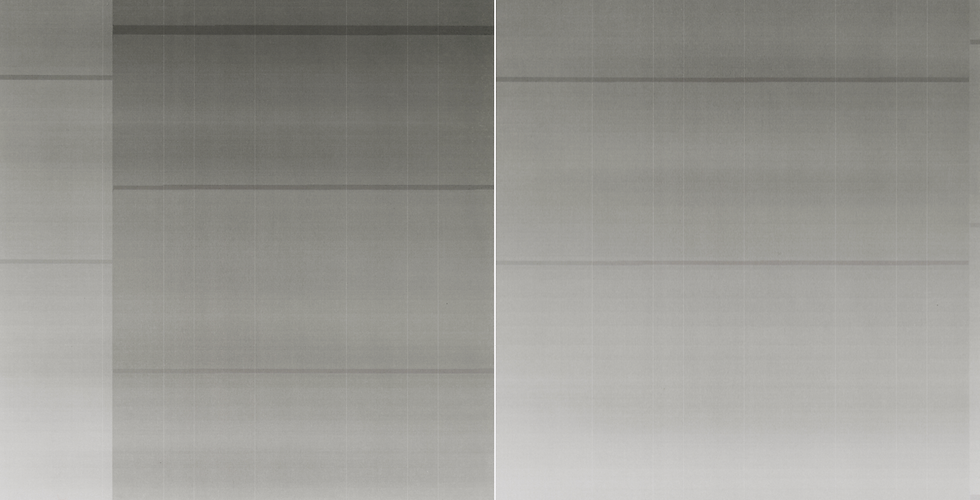
At the moment, I’d say gyakusou v.2(2024) from my painted pictures series. I created it specifically for my exhibition at LOWW in Tokyo. It was inspired by a jacket from Jun Takahashi’s Gyakusou capsule for Nike and by Japanese calligraphy. “Gyakusou” means “running”, written backwards. A detail that felt very aligned with my own approach to reworking and reinterpreting images.
Running is also something I do once a week to stay sane; it clears my head and often sparks ideas. Maybe that’s why the piece felt so personal from the start.
The work itself mirrors my overall process: it’s a blend of analogue and digital gestures. It begins with simple brush strokes made with a Japanese brush, which I digitise, edit, distort, and scale. At some point the process loops back to the file inspired by the jacket like a conversation between memories and tools.


Comments